

Claude’s curiosity is often praised.
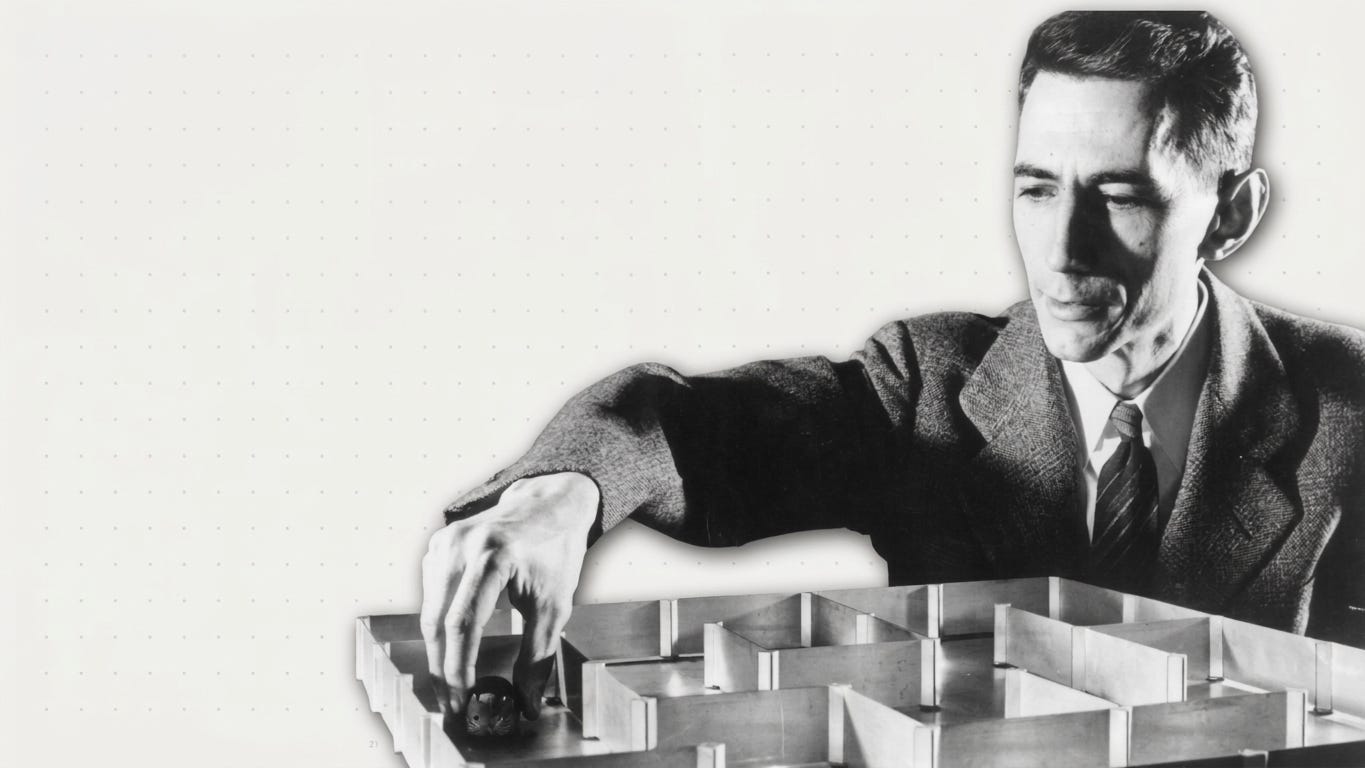
Bloggers point out how he loved juggling, unicycles, chess, his maze-solving mechanical mouse named Theseus.
He’s portrayed as a pure-hearted genius, a whimsical man-child who just wanted to play with his toys.
I thought the same, until reading what his colleague Richard Hamming said in his “You and Your Research” talk:
When you are famous it is hard to work on small problems. This is what did Shannon in. After information theory, what do you do for an encore? The great scientists often make this error. They fail to continue to plant the little acorns from which the mighty oak trees grow. They try to get the big thing right off. And that isn't the way things go. So that is another reason why you find that when you get early recognition it seems to sterilize you.
Hamming praised Shannon for his genius and contributions. But he knew him well enough to recognize that he lost his edge later in life.
It reminds me of Kobe’s analysis of Shaq. Kobe recognized him as one of the most dominant players in NBA history. But, as his teammate, he also knew him well enough to criticize his work ethic and commitment. (Shaq himself admits that he was too stubborn to diet or work on his free throws.)
Shannon’s Stagnation
It got me curious to learn more about Claude’s production. I found that it did, indeed, go down after Information Theory.
Some people speculated that he was using his clout to get out of doing much public work at all. He still made plenty of gadgets and explored his curiosity (e.g. developing a unified theory on juggling). But he didn’t take the same pains to publish his work like he did earlier in his career.
When a visitor asked about an unpublished idea, Shannon joked, “Look, you should see my attic.” His wife added they had boxes full of unfinished papers.
Curiosity’s shadow
This led me to an analysis of curiosity itself, since this was the dominant force that Claude directed his life around.
Curiosity, as opposed to interest, involves both emotion and intellect. It takes a degree of emotional investment to ask uncomfortable questions and wander into the unknown in search for answers. Claude mentioned how he felt irritated when he intuited that a solution wasn’t quite right, when it had superfluous parts or processes.
The problem is when there is no mechanism that forces you to come back to society with your solution.
Claude would follow his curiosity, get the answers, and then never tell anyone about it.
His colleagues would bring problems related to his Information Theory to him and find
He already knew about the problem
He already solved it for himself
He never shared his answers
The way out: simplicity
If you simplify your solution and give it to others, you successfully transmute your curiosity into helpfulness. It completes the hero’s journey, where the protagonists goes, seeks, finds, and returns to his tribe with wisdom and bounty.
This is exactly what Claude did with Information Theory. He simplified the problem space of digital engineering for everyone.
And this is exactly what he STOPPED doing afterwards. He avoided people, solved his own problems, and was reluctant to share his answers.
This isn’t an indictment on Claude’s character. If we all drop a gem like Information Theory, we should all have license to become hermits and retire.
Instead, it’s a cautionary tale on the supposed virtues of curiosity. Every over-developed trait has its shadow side. While heartfelt curiosity can lead to astonishing discovery, it can also tempt one to stay forever in their own world.
Keep exploring
Oral history: Claude E. Shannon (IEEE History Center / ETHW)
Article: 10,000 Hours With Claude Shannon: 12 Lessons on Life and Learning From a Genius (Jimmy Soni and Rob Goodman)
Profile / interview: Anthony Liversidge, Omni profile of Claude Shannon (1987 PDF)