

Kobe is beloved for his consistency, obsession, and attention to detail. Each of his teammates has a story about how he stayed in the gym longer, studied film closer, and continued evolving later into his career.
Yet things didn’t look so promising at the beginning. Despite entering the league at 18 with plenty of raw talent, he sat on the bench for most of his rookie year. He lacked the physical dominance of his teammate Shaq, who could neglect his diet and free throws and still become a hall-of-famer. Kobe also suffered many career-threatening injuries. Yet he always did the unglamorous work to get back on the court. As his athleticism waned later in his career, he repurposed his game around tempo, angles, and passing.
Although less storied, Richard Hamming (1915-1998) wasn’t so different.
After getting his PhD in Math at 27, he joined the Los Alamos crew on the Manhattan Project. But instead of doing the fission work, he was told to manage the IBM accounting machines they used to run bomb simulations. He described himself as a “stooge,” a “janitor of science.”
Then he got to Bell Labs, where he was again given the role of a glorified IT admin in their computer center. He only got to use the machines he managed when the big shots were gone on the weekend.
But Hamming wasn’t willing to let that hold him back from doing great work.
His plan was to load the machines up on Friday and come back Monday with a week’s worth of answers. But several weekends in a row, the machine hit an error Friday night, stalled, and gave him nothing.
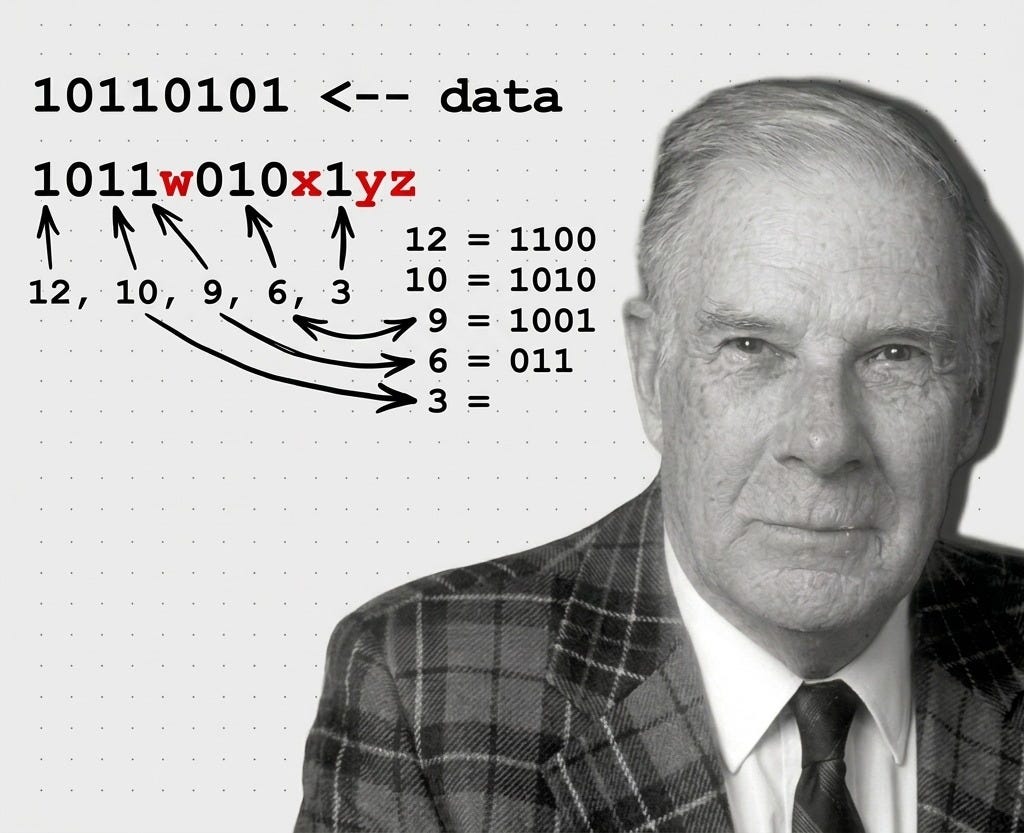
Hamming wondered whether he could get the machine to not only detect an error, but also locate where it is and flip the bit.
He obsessed over this error-correction problem for six months, working on making the machines more efficient during his off-time. He eventually came upon a novel solution that involved combining what he know about geometry with the binary calculations the computers relied on.
It worked: he got a year’s worth of work done in six months. But then he did the part most engineers skip: he patented it, wrote it up so others at Bell could use it, and eventually wrote entire books on coding theory so everyone else could too. That’s what won him the Turing Award in 1968.
After finally getting recognition, he could’ve easily coasted for the rest of his career. Instead, he quit, saying that he thought that old researchers got in the way of the fresh young ideas. Instead, he reinvented himself as a writer and speaker for the Navy.
And like Kobe, who was known to challenge his lazy teammates, Hamming refused to suffer fools or expect less of himself. He was famous for bringing a sheet of paper to meetings so that he could work on math problems when others started talking in circles. He got kicked out from the chemistry lunch table for challenging the scientists for their lack of ambition.
Kobe never had the size or athleticism as his peers like Shaq or LeBron. Hamming didn’t have the IQ of Shannon or Einstein. But they both refused to let those disadvantages temper their ambition. That’s why I admire them. They’re proof that consistent hard work can outpace raw horsepower in the race that is our careers.
HAMMING’S STATS
Richard Wesley Hamming (1915-1998, 82), born in Chicago, Illinois, on February 11, 1915, and died in Monterey, California, on January 7, 1998.
He earned a B.S. in mathematics from the University of Chicago (1937), an M.A. from the University of Nebraska (1939), and a Ph.D. in mathematics from the University of Illinois at Urbana-Champaign (1942). After a short teaching stretch, he joined the Manhattan Project at Los Alamos in 1945, programming IBM calculating machines for bomb simulations. In 1946 he moved to Bell Labs, where he stayed for 30 years and invented the error-detecting and error-correcting codes that still carry his name. He received the ACM Turing Award in 1968. In 1976 he left Bell for the Naval Postgraduate School in Monterey, where he taught until shortly before his death.
Known for: Hamming codes, Hamming distance, the Hamming window, and the lecture-turned-essay You and Your Research.
KEEP EXPLORING
Article: You and Your Research
Lectures: Learning to Learn (Hamming at the Naval Postgraduate School)