

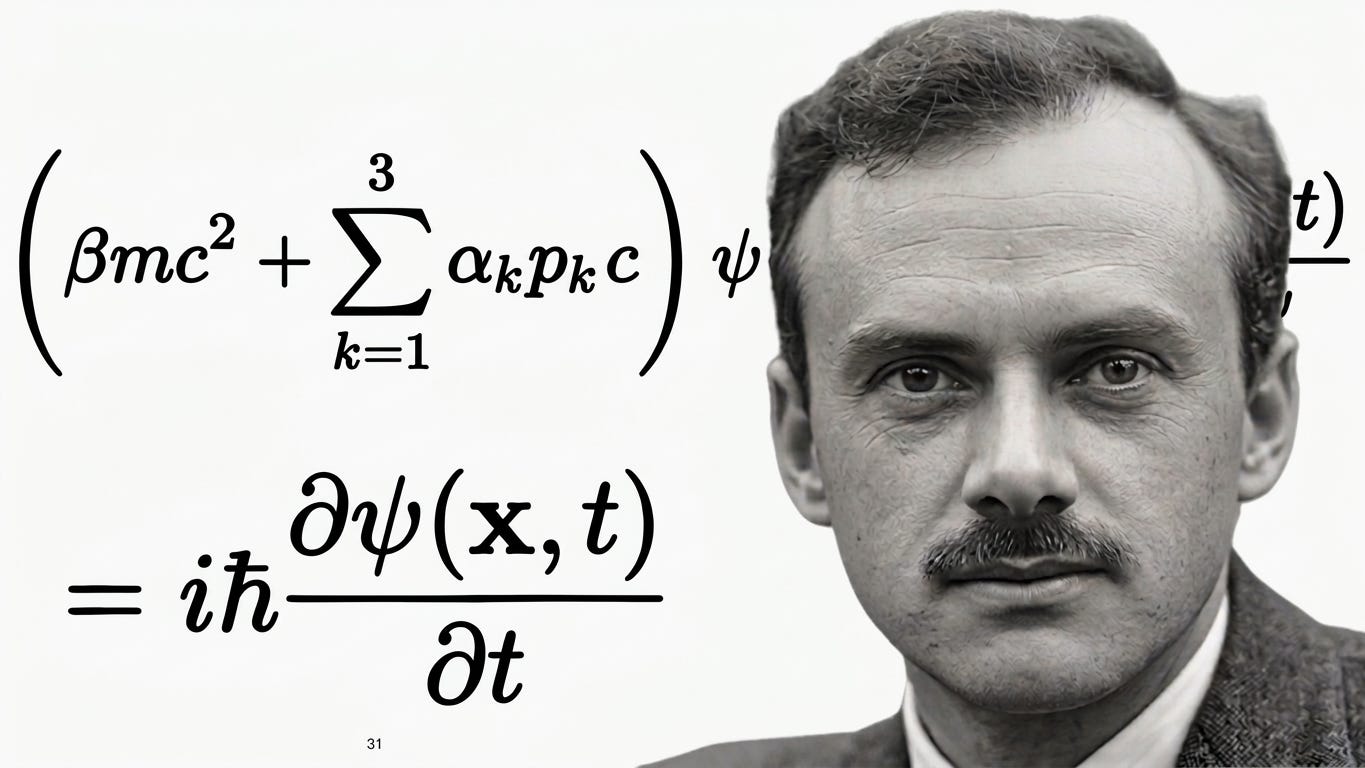
Paul Dirac’s father insisted that he become an engineer. So Paul speedran his education and graduated with a first-class electrical engineering degree at nineteen. But after failing to land a job, he went back to school to study math and physics. Over the next decade, he crushed it:
Wrote the equation that describes the electron
Founded quantum electrodynamics
Predicted antimatter
Discovered Fermi-Dirac statistics (which every transistor depends on, btw)
Took Newton’s old chair at Cambridge
Won the Nobel Prize at thirty-one
Not bad for an unemployable electrical engineer.
In light of his academic success, it’s tempting to see his engineering era as nothing more than an unnecessary side quest. One wonders how anyone could picture the shy and “slovenly” young Paul in a factory. Wouldn’t he have been better off studying math all along?
Surprisingly, no.
Although Dirac never became an engineer, his training as one gave him an unexpected edge as a mathematician and physicist. You can see this most clearly in three habits that he never dropped.
1) Tolerating imperfection
Before studying engineering, Dirac had a mathematician’s appetite for exactness. An equation was either right or it was wrong. After seeing the inevitable rounding and safety margins that emerged naturally while working with circuits and rotors, Dirac started to see math as a tool to get accurate (enough) answers for the problem at hand. He studied fellow engineer and mathematician Oliver Heaviside and his step function, which made it easy to study the pulses of currents through circuits. No one really understood them, though, including Heaviside. Mathematicians mocked the function because it lacked rigor. Heaviside didn’t care, summarizing the engineer’s perspective rhetorically: “Shall I refuse my dinner because I do not fully understand the process of digestion?”
Paul always sided with the engineers on this issue.
“I owe a lot to my engineering training because it [taught] me to tolerate approximations. Previously to that I thought…one should just concentrate on exact equations all the time. Then I got the idea that in the actual world all our equations are only approximate. We must just tend to greater and greater accuracy. In spite of the equations being approximate, they can be beautiful.”
After pivoting to academics, Dirac proved unusually comfortable dropping unnecessary terms and trusting his instincts, which his singular-minded math peers couldn’t do. Paul had a sense of freedom in a field that overemphasized rigor for its own sake.
Another clear example of this approximation at work is his delta function, which returned zero everywhere except at zero, where it’s infinitely large. Mathematicians claimed that no such function could exist, and they were technically right. But it worked, which was enough for both Dirac and Heaviside. Both were happy to use a method that worked and let the math catch up later. (It took another two decades before Laurent Schwartz’s theory of distributions put the delta function on solid theoretical footing.)
2) Visualizing reality
Engineering taught Dirac to turn a blind eye to the lure of perfection, but it also taught him to see. During high school and undergrad, he practiced geometric drawing, which taught him to visualize complicated objects in motion from different perspectives. He considered cylinders and cones in motion, and learned to see in his mind’s eye in ways that he never could’ve if he confined himself to static algebra.
These drawings primed him to learn projective geometry, a study of perspective that encouraged geometric over algebraic approaches. It challenges students to think not just about distance between points, but their relationships at different angles. Most found this difficult. Dirac ate it up.
Projective geometry I found a most fascinating subject. One could get quite powerful results — theorems about straight lines and conics intersecting each other — just from elementary arguments about 1 to 1 correspondence. That appealed to me very much. All my work since then has been very much of a geometrical nature, rather than of an algebraic nature.
— Dirac (AHQP interview, 1 April 1962)
Physicist Freeman Dyson noticed Dirac’s visual skill. Dyson marveled at how he could seemingly conjure laws of nature from pure thought. His discoveries were like “exquisitely carved marble statues, falling out of the sky, one after another,” Freeman said. Wolfgang Pauli might’ve had the same impression. His joke that “There is no God, and Dirac is his prophet” was as much a quip about Dirac’s atheism as it was a compliment about his visual imagination. I can’t help but think that the visual practice from his engineering education helped him probe nature more effectively.
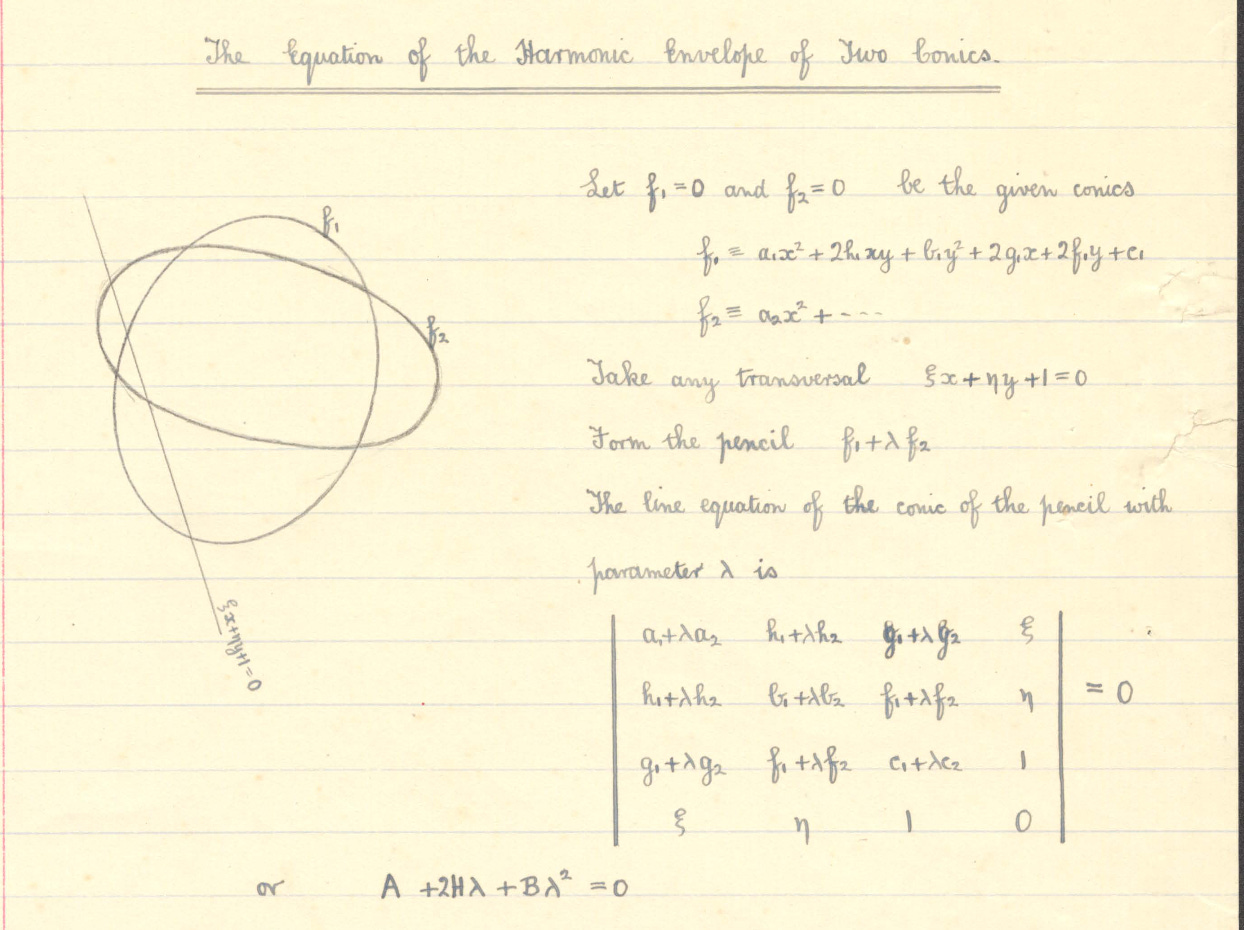
Seeing a problem clearly is half the battle. The other is ensuring it stays clear after you write it down.
3) Mastering symbols
In 1939, sixteen years into his physics career, Dirac submitted a three-page paper titled “A New Notation for Quantum Mechanics.” In it, he argues that the standard notation’s mix of linear and coordinate operations “do not fit together naturally” and “give rise to an awkward jump in the flow of one’s thoughts.” Then he proposes “bra-ket” notation. A quantum state was a ket, |ψ⟩; its corresponding dual was a bra, ⟨φ|; and their pairing as ⟨φ|ψ⟩ — a bracket. Instead of forcing physicists to mentally switch between the abstract and concrete, this “unification of ideas” allowed them to stay in one symbolic system. No wonder why, eighty-seven years later, physicists and quantum-computing engineers still use it.
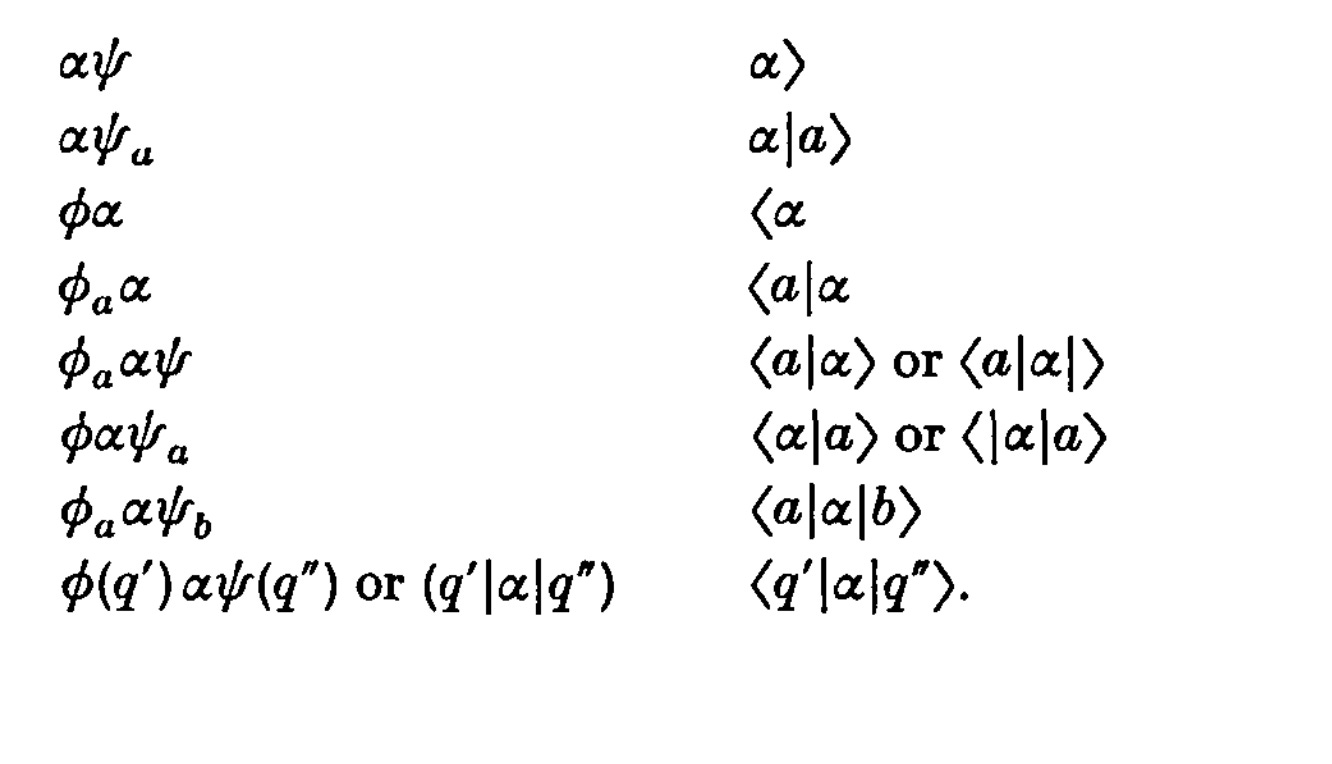
When asked how he could manipulate symbols so easily, Dirac mentions how he had to calculate the breaking stress of structures as part of his general engineering training, which forced him to get familiar with new symbols.
He refers to this training again when considering how he came up with delta functions, a generalized way to model mass and load, which he says were inspired by electrical circuits and stress diagrams.
I think it was probably that sort of training that first gave me the idea of a delta function because when you think of loads in engineering structures, sometimes you have a distributed load and sometimes you have a concentrated load at the point. Well, it’s essentially the same whether you have a concentrated load or a distributed load but you use somewhat different equations in the two cases. Essentially it’s only to unify these two things which sort of led to the delta function.
— Dirac (Kuhn AIP interview)
Dirac’s symbol work feels like a side quest born out of pure irritation, like Linus inventing git in a few weeks so he could keep his kernel repo organized. If Dirac were a SWE, he’d have created his own mathematical programming language. Instead, he created new symbols that unified two ways of reasoning about quantum mechanics.
This work stemmed from a deep instinct for abstraction that he maintained throughout his career. His delta function unified concentrated and distributed loads mathematically; his notation unified abstract states and coordinates; his physics unified quantum mechanics with special relativity. He never became a structural engineer, but the guy couldn’t help building bridges.

Takeaway
Much like my liberal arts degree, Paul’s engineering training didn’t land him a job. But it did give him something more durable: pragmatism. He used this intuition to approximate without apology, visualize relationships, and invent better abstractions when the others got in his way. His skill at combining engineering with theory might’ve been why his discoveries were so unexpectedly elegant.
If you’re a software engineer worried about what’s left once agents write all the code, I hope Dirac’s career is encouraging. Frameworks go out of style. Languages die. Job listings disappear. Your coding skills might not be as necessary as anticipated, but the sensibilities you developed while learning them will stay with you for a lifetime.
Further Exploring
Essays: Paul Dirac’s papers. Scanned and organized into a GitHub repo.
Blog: When simplicity isn’t enough (me). What SWEs can learn from the Dirac equation.
Book: The Strangest Man: The Hidden Life of Paul Dirac, Quantum Genius (Farmelo).
Book: A history of mathematical notations (Cajori). More symbol stories.
Audio: Basic Beliefs and Prejudices in Physics (Dirac). 58-minute Nobel speech.
Video: Why is there antimatter? (Veritasium). A meaty yet approachable explanation of Dirac’s equation.
“The main problem of the engineer is to decide which approximations to make.”
-- Dirac, The Engineer and the Physicist (1980)