

1915-1998 (82)
Born in Chicago. B.S. in mathematics (University of Chicago, 1937), M.A. (University of Nebraska, 1939), Ph.D. (University of Illinois, 1942). Ran computing at Los Alamos (1945-1946), spent thirty years at Bell Labs in Murray Hill, New Jersey (1946-1976), then taught at the Naval Postgraduate School in Monterey, California until shortly before his death.
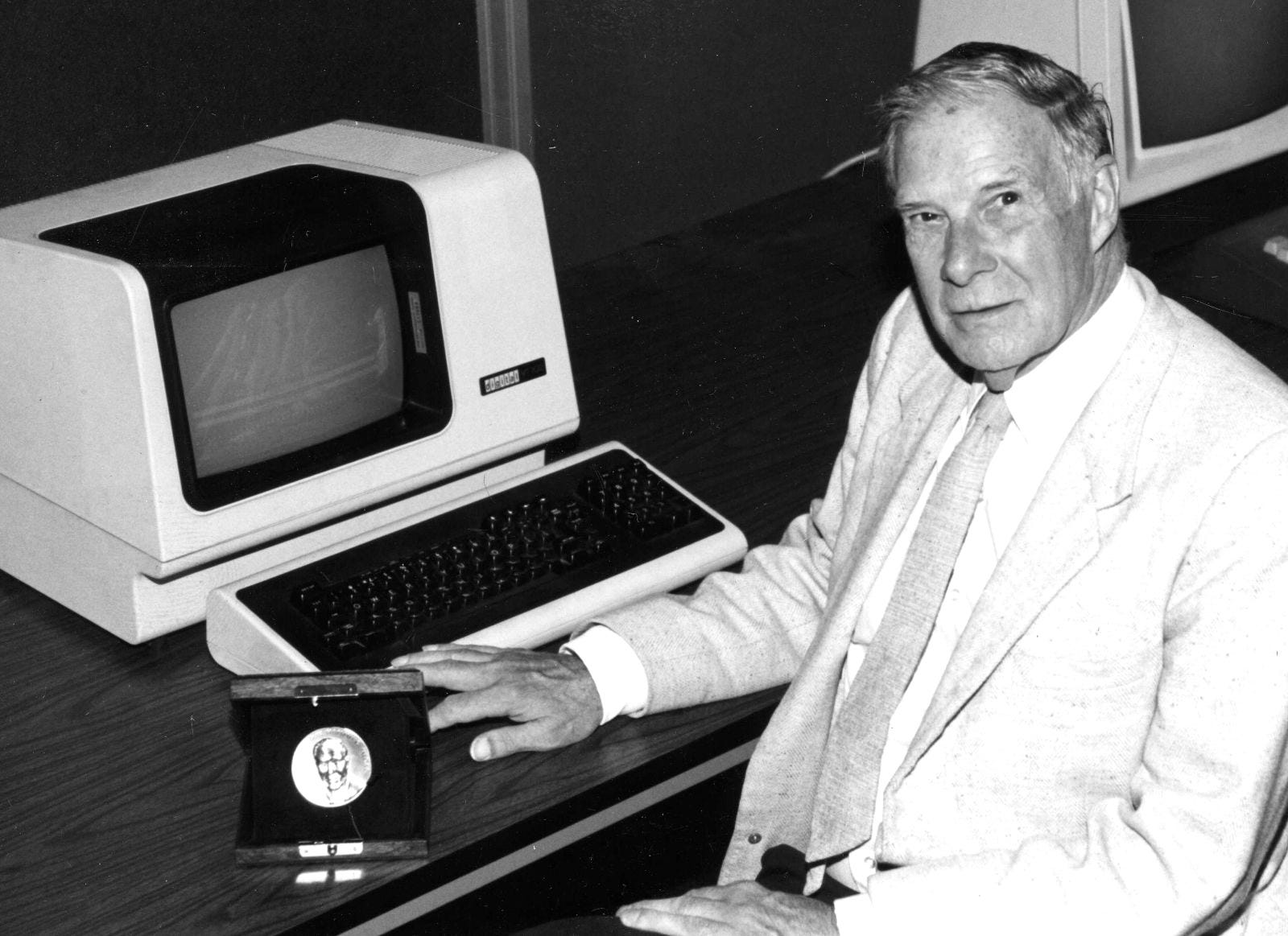
Major accomplishment
Invented the Hamming codes (error-detecting and error-correcting codes) that made reliable digital communication practical, from telephone switches to modems, disks, and satellites. Won the ACM Turing Award in 1968 for numerical methods, automatic coding systems, and those codes. Later distilled what he learned watching Shannon, Feynman, Shockley, and the rest into “You and Your Research,” still one of the clearest guides to doing significant technical work.
Quote
“If you do not work on an important problem, it’s unlikely you’ll do important work. It’s perfectly obvious.”
Fun fact
For years he kept “Great Thoughts Time”: after Friday lunch he would only discuss big questions (Where is the field going? What will computers do to science?). He says dedicating ten percent of the week thinking big helped him avoid wasting time working on the wrong things.
Takeaways
Ask the lunch-table question: What are the important problems in your field, and are you working on one of them? If the answer is ‘no,’ why not?
After a win, keep planting acorns (ie, working on small problems). Hamming points out that Shannon and the other Nobel-Prize winners later refused to work on the small problems, which prevented them from a great encore.
Prepare your mind on purpose. If you commit all your mental energy on a problem, your subconscious will keep working on it from different angles. Also leave the door open enough to hear which problems matter.
Keep exploring
Article: You and Your Research (1986 Bellcore transcript)
Video: Hamming, “You and Your Research” (June 6, 1995) (him delivering the talk)
Book: Richard W. Hamming, The Art of Doing Science and Engineering: Learning to Learn