

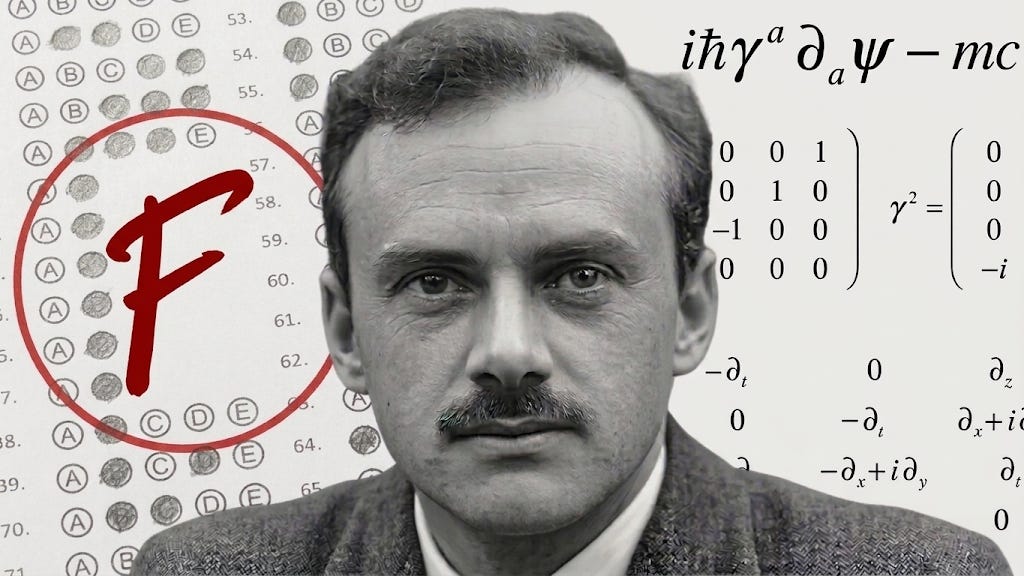
Broke, inexperienced, and beaten down by a brutal job market, Paul Dirac gave up on finding an electrical engineering job to pursue a math degree. It worked out pretty well from there: within a few years, he wrote the equation that describes the electron, predicted antimatter, and won the Nobel Prize at thirty-one. Let’s take a closer look at how Dirac found his place in the 20th century, and consider how we can do the same in the 21st.
What happened
Paul Dirac didn’t pursue engineering as much as he inherited it. His father saw engineering as a practical career for his two smart boys. The pay was decent, and the education was cheaper than medicine or academics. The deciding technologies of World War I — wireless, aircraft, tanks, mass-produced munitions — had just shown what engineers could do. Peacetime promised even more engineering work. Aviation was booming, and wireless was moving from military radios into ordinary homes. Electricity itself was barely adopted at home: only 6% of British homes had it in 1919. Parliament passed the Electricity Act that same year to start pulling Britain’s patchwork of small local power companies into a national system. Decades of wiring, building, and modernizing lay ahead.
An electrical engineering degree looked like a smart bet. Paul’s father had already steered his older brother to abandon his dream of becoming a doctor in favor of mechanical engineering. Paul, brighter and less confrontational, was next.
Dirac enrolled at the University of Bristol at sixteen, where he got a solid theoretical foundation in physics, chemistry, and math. But it was still focused on engineering. He worked in labs, experimenting with bridges, circuits, pulleys, pumps, internal combustion engines, hydraulic cranes, and steam turbines. By nineteen, he had a first-class degree in electrical engineering. On paper, things looked promising.
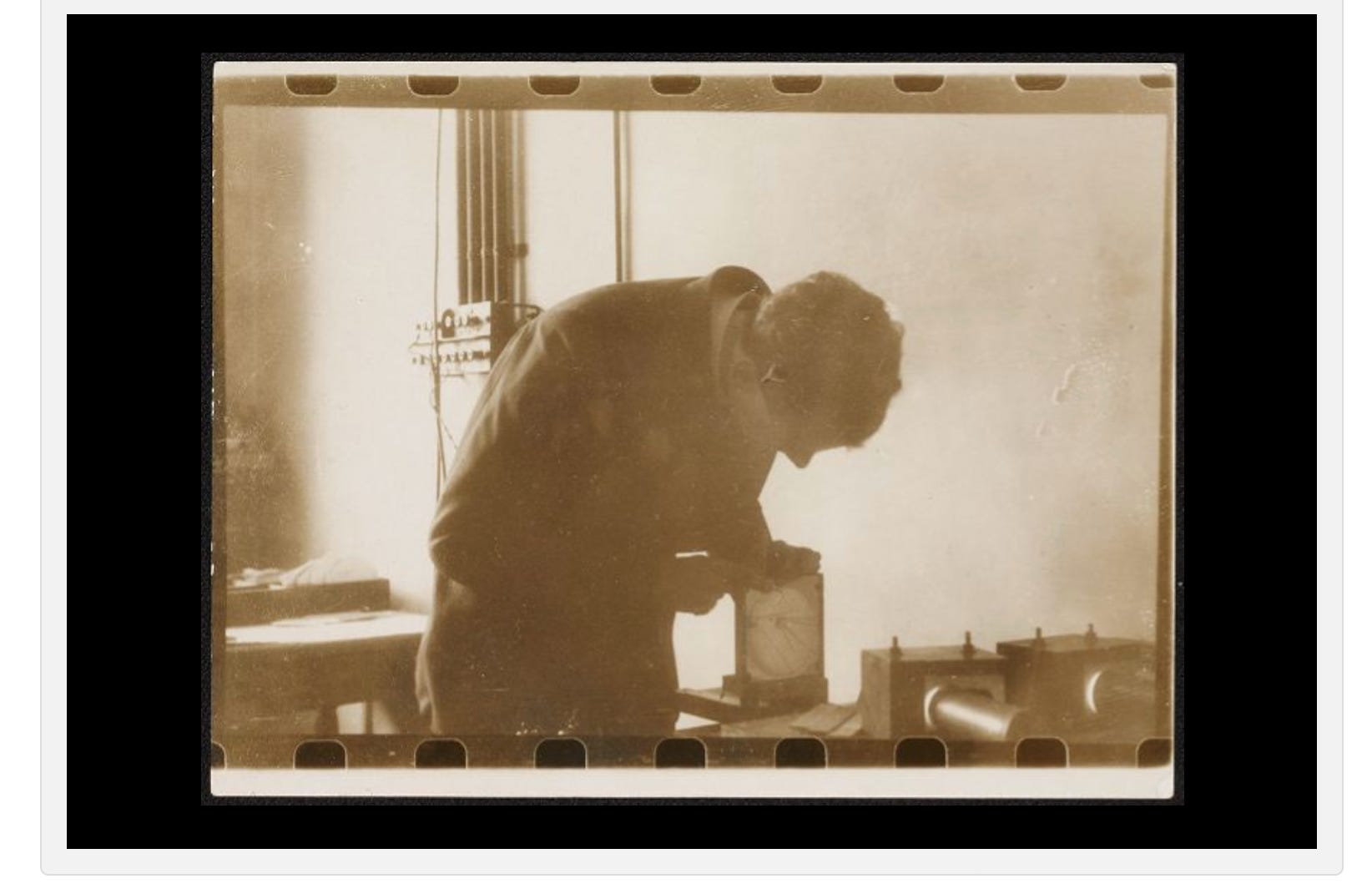
But the first sign of trouble came during the summer of 1920 when he took an internship at an electrical goods factory to see if he was suited to factory work. He wasn’t. His employer gave him the only poor report he would ever receive. They said he was “a positive menace,” that he “lacked keenness,” and was “slovenly.”
Dirac didn’t disagree — he knew engineering wasn’t a good fit. He was awkward, fumbled with equipment, and felt out of place on the factory floor. He liked engineering theory far more than applying it in the lab.
By the time Dirac graduated, Britain’s postwar boom had collapsed, sending the country into the worst depression since the Industrial Revolution. Unemployment among insured workers had reached 23%. Two million people were unemployed, and another million were working minimal hours. There were no real-world job prospects for the underage, slovenly Dirac — regardless of how smart he was in the classroom.
Dirac responded not with a bold leap, but a series of small, slow, casual steps. He applied for a job in the burgeoning aviation industry, but got rejected. He took the Cambridge entrance exam, an event his father helped plan. Paul passed and won an award worth £70 per year ($6k today), but it wasn’t enough to cover living expenses.
Then Bristol’s math department offered him free tuition, which he accepted. Finally, he had a viable path forward. He moved back in with his parents, skipped the first year on the strength of his engineering degree, and finished in two, graduating with first-class honors in 1923. This time, the money came together: a £140 government research grant, the £70 scholarship from St John’s, and a gift from his father to cover the rest. In October 1923, three years after his EE internship, Paul finally arrived at Cambridge.
For the first time, Paul was surrounded by researchers who valued the very qualities that had made him a poor fit for factory work: his mathematical intuition, independence, and appetite for abstract problems. After years of trying in vain to fit into factory life, he’d found an environment that fit him. What followed was almost inevitable.
Dirac received his PhD in 1926, at which point he had already made major contributions to the new quantum mechanics. In 1927, he became the first to apply quantum mechanics to the electromagnetic field, helping lay the foundations of quantum field theory. In 1928, just seven years after sitting on the sidelines as an unemployed engineer, he derived the equation that brought special relativity and quantum mechanics together, accounted for electron spin, and contained the mathematical seeds of antimatter.
Then he kept winning.
He wrote The Principles of Quantum Mechanics in 1930, which quickly became one of the field’s foundational texts (and Einstein’s favorite vacation reading). That same year he was elected a Fellow of the Royal Society. In 1932, at thirty, he became Cambridge’s Lucasian Professor of Mathematics, the chair once held by Isaac Newton. A year later, he shared the Nobel Prize in Physics with Erwin Schrödinger for discovering new forms of atomic theory. The failed engineer had found his place as an intuitive mathematician.
TL;DR - The guy had a good engineering education, but couldn’t land a job. Then he switched to theoretical math. The field was a much better fit. In just over a decade, he became the most accomplished British researcher of the 20th century.
What if Dirac had landed the respectable electrical-engineering job his education was preparing him for? He would’ve done fine financially, but it’s hard to argue that he would’ve been as successful. Engineering seemed safe, but Paul had always been a theory guy. His unsuccessful job hunt pushed him into an environment where his quiet introspection shifted from a liability into an asset.

Why Dirac’s career pivot matters
A century ago, electrical engineering was a promising field with decades of growth ahead. Dirac did what any reasonable young person would’ve: he studied something practical, worked hard, and graduated at the top of his class. Then the economy collapsed, and the career he’d spent years preparing for suddenly looked a lot less secure.
Sound familiar?
After spending over a decade obsessing over DSA, design patterns, and the travesties idiosyncrasies of JavaScript, I assumed my technical skills were ticket for a lifetime of stable income. Then agents showed up and were like, “Nah, we got this now. You do other stuff.” It felt like I had wasted so much time building expertise I wouldn’t need anymore.
Dirac probably felt something similar in 1921. He’d spent three years learning to build circuits, test turbines, and calculate loads on bridges, and nobody wanted to pay him for any of it. But his engineering years weren’t wasted. Engineering had trained him to get a usable answer out of messy math. His PhD research connected Heisenberg’s strange new quantum theory to the classical mechanics he’d learned as an engineer. He even invented the delta function, a pragmatic mathematical tool with an engineer’s spirit that physicists still use today. He stopped being an engineer, but he never stopped thinking like one.
Skills depreciate fast, but the sensibilities they produce don’t.
Maybe you won’t manually implement any CRUD endpoints anymore. But years spent doing so will leave you with an instinct for catching flimsy abstractions. The code reviews will have hardened your preference for simplicity. Seeing things break in prod will teach you which details matter and which don’t. Like Dirac, you can carry those instincts into whatever comes next.
The comparison isn’t perfect, though. Dirac’s field didn’t disappear. Britain still needed engineers; a bad economy just meant it couldn’t hire him yet. Our situation is different: the work itself is changing, not just the job market. And Dirac already knew where he wanted to go. Math and relativity had pulled at him for years, so when engineering became a dead end, he didn’t have a problem changing paths towards something he actually loved. Many engineers today are being pushed out of a role before they know what to pivot toward.
Career-personality fit
Dirac’s path also highlights the importance of finding a career that aligns with your personality.
YC alums love talking about Product-Market Fit (PMF) as a flawless metric for viability. They tell founders that finding it is their only responsibility — to feverishly iterate until the moment they stop pushing their product and users start pulling it out of their hands because they actually need it. Even if the founders are brilliant MIT dropouts, the startup is doomed if they can’t make customers pull out their credit cards. PMF proves that they’ve applied their IQ to something that people actually want.
Careers work similarly. You can be smart, hardworking, and well-trained while trapped in a game that penalizes your natural tendencies.
Dirac was passive, quiet, and hated collaboration. Cambridge colleague Nevill Mott recalled that Dirac rarely discussed his research before publishing it. His discoveries often seemed to appear fully formed, without the usual conversations among colleagues. He also hated attention. He instinctively tried to turn down the Nobel Prize, only to realize that doing so would demand even more attention.
This style doesn’t work at the factory, where engineers had to handle machinery, coordinate with coworkers, and speak up. A professorship, where Dirac could think quietly on his own, was a perfect fit for his personality.
Not everyone is suited to founding a unicorn startup, but we can all assess whether the rhythms of our field align with the rhythms of our personality.
The tricky part for modern engineers is that AI has changed everything. Even if we fit into this field perfectly in 2024, we’re left wondering if we still will in 2028.
The push
As AI takes on more everyday engineering tasks, we'll need fewer code monkeys, fewer ticket slayers, fewer CRUD plumbers. Sure, we’ll still need some pure SWEs, especially those good at system design. But we’ll need fewer of them. Would-be SWEs left on the sidelines will need to pick a new path: closer to the problem, or closer to the customer.
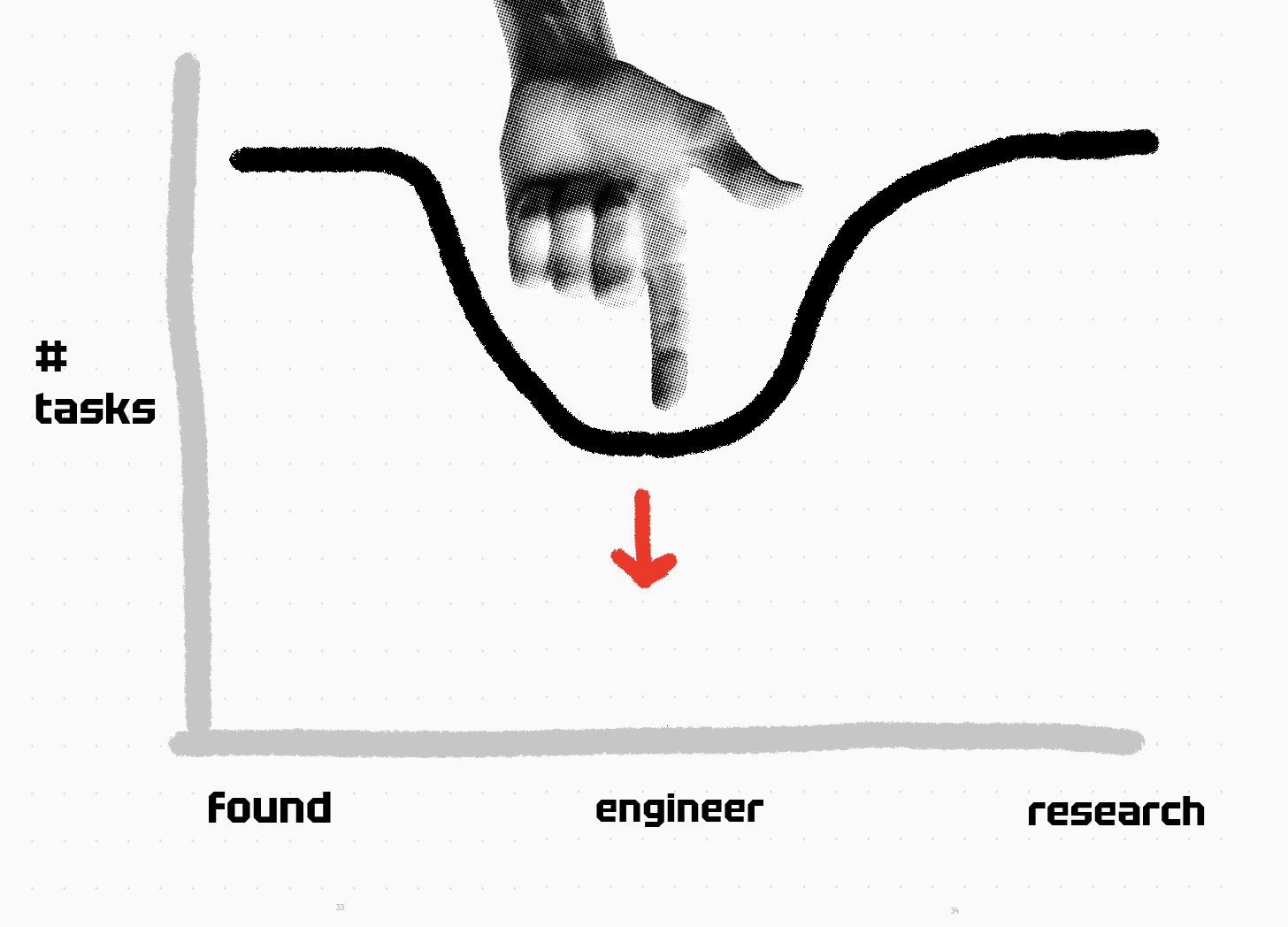
One path leads toward specialization: research, systems work, domain expertise, experimentation, invention. The other leads toward ownership: products, customers, distribution, leadership, entrepreneurship. Let’s look at the practical differences between these paths.
Software Engineer (Legacy)
Tasks: PRs, RFCs, grooming issues, deep work on DSA and tooling, perf optimization. Using existing things (languages, frameworks, tools)
Peak Role: Principal Software Engineer
KPI: PR velocity
Talks To: PMs, SWEs
Work Environment: Hybrid, office-casual. Frequent meetings
Assets: Grit, reliability, resourcefulness
Liabilities: Permission-seeking, reluctance to learn
Archetype: Linus, Paul Buchheit
Researcher
AKA: Subject matter expert, specialist, domain expert, consultant
Tasks: Model tuning (evals, benchmarks, data), hardware engineering, context engineering (memory, token efficiency), creating new things (theories, architectures, hardware)
Peak Role: Professor, Senior Researcher, Inventor
KPI: Model performance (benchmarks)
Talks To: Researchers, students, PMs
Work Environment: University, remote, quiet office, deep work, few meetings.
Assets: Contrarian ideas, invents new things, T-shaped knowledge (deep speciality, broad understanding), loves problem space, embraces ambiguity
Liabilities: Extroversion, dislikes deep work, jumps to naive solutions
Archetype: Claude Shannon, Paul Dirac, Richard Hamming, any Researcher that the labs fought over in 2025
Founder
AKA: Creator, entrepreneur, community builder, businessperson
Tasks: Campaigns, releases, launches, pricing, publishing content, pitching, branding.
Peak Role: Technical Founder
KPI: Profit, valuation
Talks To: Customers, business people, employees
Work Environment: Remote or in-office. Casual, dynamic, less structure
Assets: Storytelling, empathy for customers, resourcefulness, grit, clarity
Liabilities: Resistance to marketing, uninspiring, focusing on self instead of customer
Archetype: Peter Steinberger, DHH
Which list of tasks sounds energizing, and which sounds like a chore? Which liabilities feel uncomfortably familiar? You probably have a good hunch about which is right for you, but test it. Spend a weekend as a researcher by reading papers. The next weekend, be a founder by shipping a tiny product and recruiting users. One of those is sure to feel more natural.
Remember: you’re trying to find the work style that you’re uniquely suited for — not the most obvious route to a paycheck.
Then commit.
If you’re becoming a researcher: build your expertise. Devour technical books and papers. Present. Run experiments. Go to grad school. Skim Key Person of Influence. Talk to the experts.
If you’re taking the founder path: ship. Share your story. Be useful. Recruit. Outsource more to AI. Talk to users.

Final word
Dirac did everything a young person is told to do. He studied something practical, worked hard, graduated at the top of his class … and still found himself unemployed. Navigating his early career demanded an unordinary degree of patience. He bombed his internship. Aviation, the hot new field, didn’t want him. Cambridge was too expensive. Then he stumbled into math. He kept pushing forward until, almost accidentally, he arrived at the theoretical frontier of quantum mechanics, where he belonged all along.
A century after Dirac’s false start as an electrical engineer, software engineers face a similar fork in the road: towards ideas, or towards people? It’s our turn to pick a path, work hard, and see where it leads us.
Further exploring
Essay: You and Your Research (Richard Hamming). Classic Bell Labs talk. Good for the researcher path.
Essay: Maker’s Schedule, Manager’s Schedule (Paul Graham). On choosing work that fits your personality.
Essay: Remember getting stuck? (me). Deep thinking in the AI era.
Essay: Adapting for a world of software factories (Zach Lloyd). The new software engineering.
Book: The Strangest Man: The Hidden Life of Paul Dirac, Quantum Genius (Farmelo).
Archive: FSU’s digital Dirac Collection. Notebooks, formulas, pics, his dissertation, and random goodies.
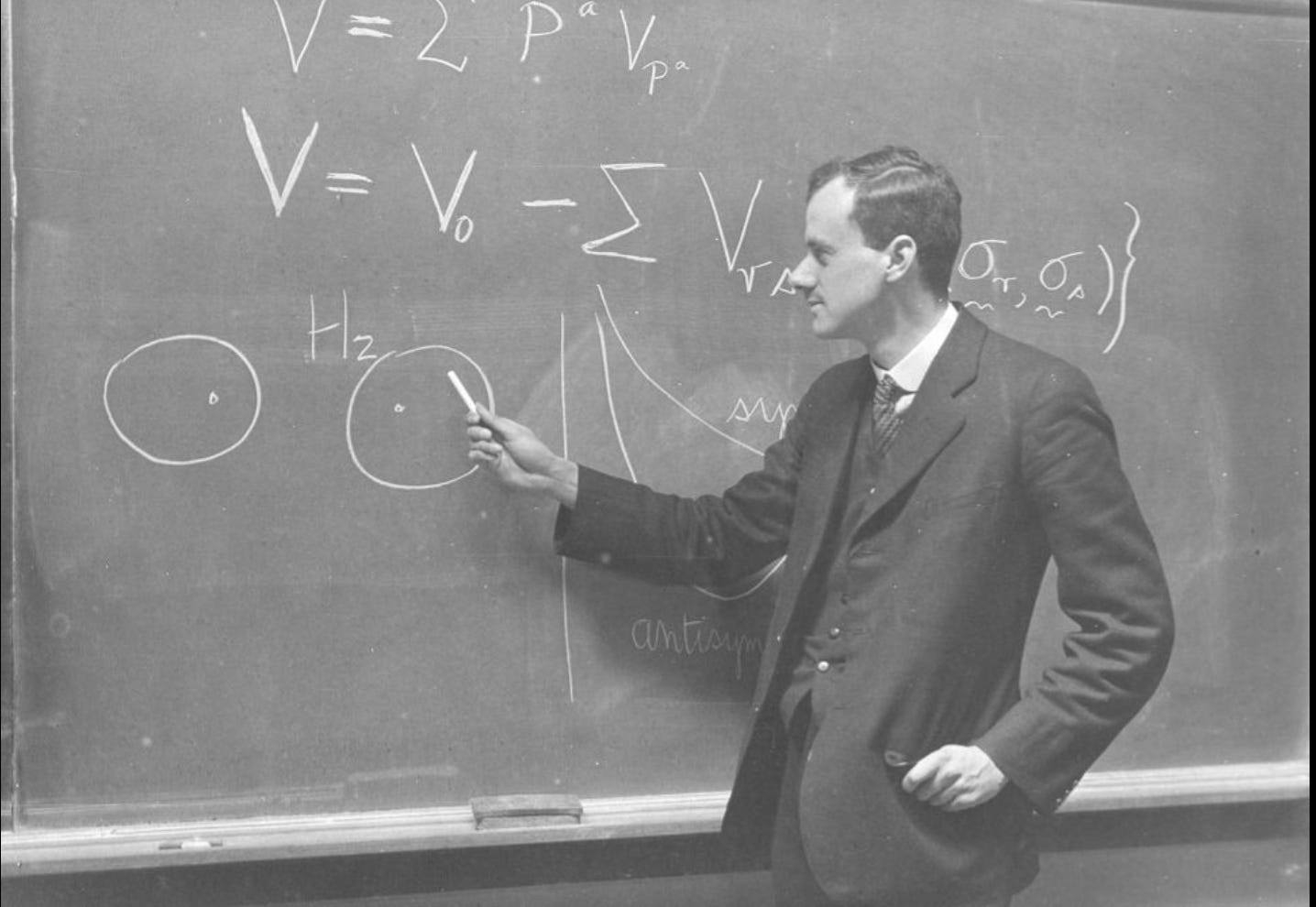
“I went back to Cambridge [...] and resumed my previous style of life, intense thinking about these problems during the week and relaxing on Sunday, going for a long walk in the country alone.” — Paul Dirac on his lifestyle. Physically chill, intellectually hardcore.